
Let’s be honest—recessions are like that one relative who always shows up uninvited, eats your snacks, and stays just a little too long. And while we may not be able to stop a recession from happening, we can prepare for them—especially if you’re retired and counting on your savings to last longer than your neighbor’s garden gnome obsession.
So what exactly is a recession, why should retirees care, and most importantly—how can you ride it out like the financial rockstar you are (without eating beans for every meal)? Let’s dive in.
What Is a Recession, Anyway?
Think of a recession as the economy catching a cold—but one that lasts a while, makes people nervous, and can mess with everything from your 401(k) to the price of peanut butter.
Technically, a recession is a significant decline in economic activity that lasts more than a few months. It usually means higher unemployment, slower consumer spending, and sometimes scary headlines on the news.
For seniors and retirees, this can be especially stressful. Why? Because you’re likely living on a fixed income, depending on retirement savings, pensions, and Social Security. When prices go up or your investments take a dip, that nest egg starts looking more like a scrambled egg.
Why Should Retirees Prepare for a Recession?
You’re no longer bringing in a steady paycheck, so any economic downturn hits differently. While younger folks might bounce back with new jobs or side hustles, retirees need to be a little more strategic. After all, you’ve got better things to do—like perfecting your golf swing or rewatching The Golden Girls.
When you’re retired, your money is no longer coming from a paycheck—it’s coming from savings, Social Security, pensions, or investments. And unlike during your working years, there’s no quick way to “make up” losses if something goes sideways. That’s why recessions can hit retirees harder.
Here’s why it really matters:
🏦 1. You’re on a Fixed Income
While prices go up during a recession (hello, $6 cereal!), your income usually doesn’t. Hence the term “Fixed Income”. Social Security might get a cost-of-living adjustment, but it rarely keeps pace with inflation. If your expenses rise and your income stays the same, your budget suddenly feels like it shrank two sizes overnight—Grinch-style.
📉 2. Your Investments Are More Vulnerable
Retirees often have a chunk of their retirement income tied to investments like stocks, bonds, or mutual funds. And when the market dips, so does the value of your portfolio. If you’re withdrawing from those accounts during a downturn, you risk locking in losses—basically selling your stuff on clearance when you’d rather wait for full price.
⏳ 3. There’s Less Time to Recover
You’ve worked hard, and you want to enjoy retirement—not spend it rebuilding your portfolio like a financial phoenix. Unlike younger folks, retirees don’t have decades to wait for markets to bounce back or income to grow. A big loss now could mean cutting back later, and no one wants to trade vacations for ramen noodles.
💳 4. You May Face Surprise Expenses
Let’s face it—life gets spicier with age. Medical bills, home repairs, helping adult children (who still can’t figure out how to do their taxes)—these things can show up during a recession when money is already tight. If you’re not prepared, these surprise costs can derail your plans faster than a squirrel at a bird feeder.
🧘♂️ 5. Stress Isn’t Fun at Any Age
Worrying about money in retirement is the opposite of relaxing. Recession-proofing your finances now means more peace of mind later. Instead of watching the news with clenched fists, you can sip tea, pet the dog, and say, “Ah yes, I planned for this.”
🛠️ Top Tips to Recession-Proof Your Retirement (Things to Do Right Now)
When the economy starts to wobble, it’s time to take action—not panic. Retirees don’t need to overhaul their entire lives to stay financially secure during a recession. A few smart moves can make all the difference.
Here are the top expert-backed tips to help you batten down the financial hatches—starting today.
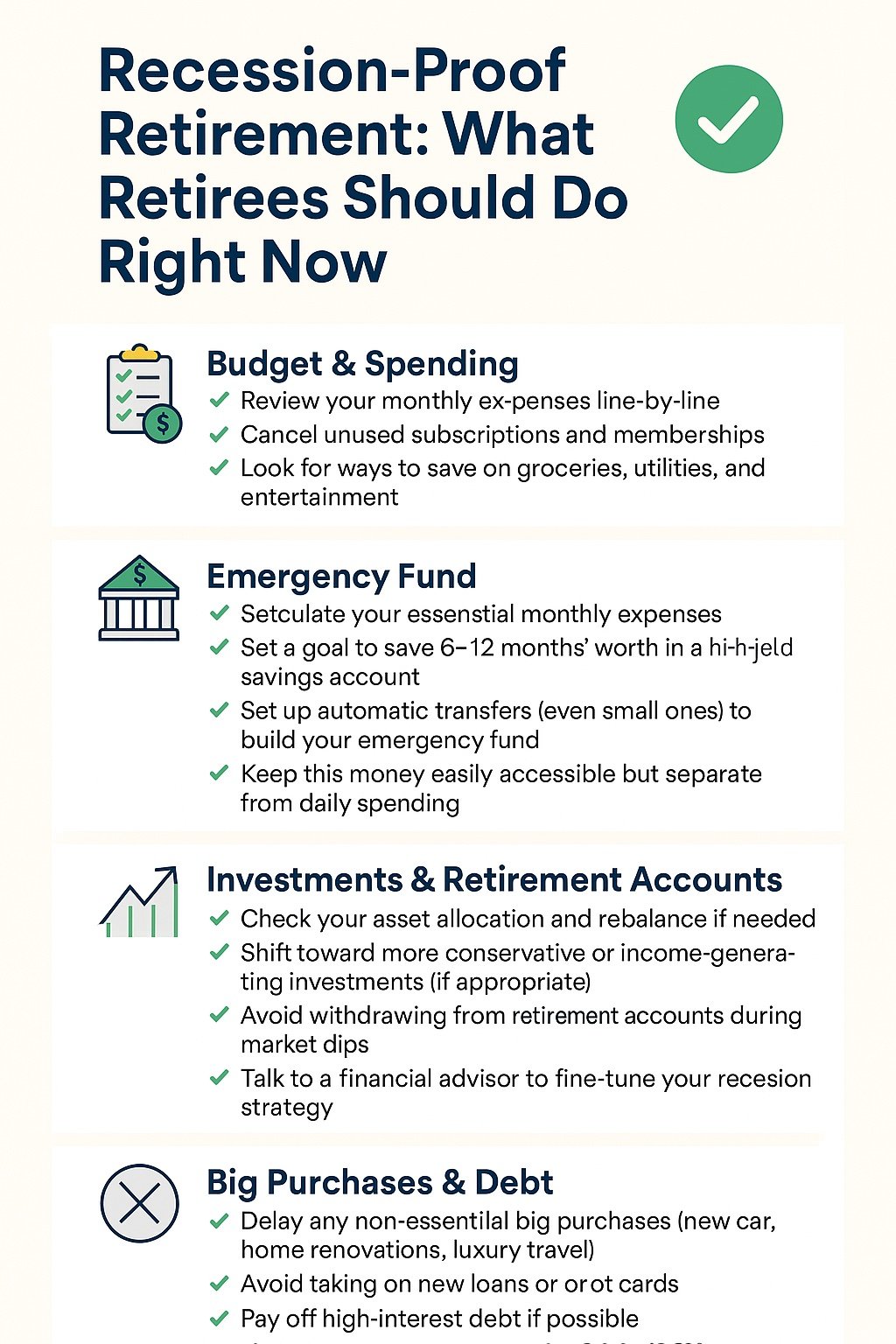
1. Reevaluate Your Monthly Budget (Like, Right Now)
Before anything else, grab a cup of coffee and look at your spending. Every dollar should be pulling its weight.
✅ ACTION STEPS:
- Print your last 2–3 months of bank and credit card statements.
- Highlight recurring expenses—subscriptions, memberships, utilities, and groceries.
- Identify areas to trim without giving up joy. (Keep your morning crossword subscription, ditch the unused gym membership or streaming service.)
- Shop around for better prices. Look at recurring bills and see where you can reduce. Phone, internet, streaming, and insurance are all areas that offer a wide range of pricepoints.
- Create a simple “recession version” of your budget with a little more wiggle room.
Pro Tip: Use budgeting apps like Quicken, YNAB or Empower—or good old-fashioned spreadsheets.
2. Strengthen Your Emergency Fund
This is your recession parachute. Ideally, you want 6 to 12 months of essential expenses saved in a safe, accessible place.
✅ ACTION STEPS:
- Calculate your bare-minimum monthly costs: housing, food, meds, and utilities.
- Multiply by 6 or 12—there’s your goal.
- Park that money in a high-yield savings account (many online banks offer 4% or more right now).
- Start with what you have—don’t stress if it’s small. Consistency is better than perfection.
3. Rebalance Your Investment Portfolio
Don’t just “set it and forget it”—especially when markets get choppy. Rebalancing ensures you’re not taking on more risk than you want.
✅ ACTION STEPS:
- Call your financial advisor or use your investment platform to check your current asset mix.
- Consider shifting some investments to more conservative assets (like bonds, CDs, or dividend stocks).
- Avoid withdrawing from stocks during downturns—this locks in losses.
- Consider a bucket strategy: one bucket for short-term needs (cash), one for medium-term (bonds), and one for long-term growth (stocks).
Pro Tip: Don’t panic-sell during a dip. Even the worst bear markets recover eventually.
4. Delay Big Purchases (Unless Absolutely Necessary)
That new car, kitchen remodel, or cruise can wait. During a recession, cash is king and flexibility is gold. This is especially true when tariffs and a trade war ensue!
✅ ACTION STEPS:
- Make a list of upcoming big-ticket items.
- Separate them into “must-have now” and “can-wait-a-bit” piles.
- Postpone what you can to preserve liquidity.
Pro Tip: If you must spend, look for deals—recessions can potentially bring deep discounts. Shop refurbished or used.
5. Maximize Your Social Security Benefits
If you haven’t started drawing yet, consider delaying. Each year you wait (up to age 70) increases your monthly payout.
✅ ACTION STEPS:
- Use the SSA.gov calculator to compare claiming now vs. later.
- Factor in your health, longevity expectations, and other income sources.
- Talk to a financial planner about the best claiming strategy.
Pro Tip: If you’ve already started, don’t worry—just focus on managing expenses and protecting your savings.
6. Explore Low-Stress Side Income
Even a little extra money each month can help your savings go further. Use a recession as an opportunity to declutter your house. Used items are often at a premium during economic downturns. And yes, that side hustle can be fun!
✅ ACTION STEPS:
- Sell your clutter online. Those used or vintage items, collectibles, or handmade goods can all be sold on various online platforms.
- Rent out a room, garage space, or RV parking spot.
- Offer part-time services based on your skills: tutoring, consulting, baking, or pet sitting.
Pro Tip: Look for things you enjoy doing. If it feels like a chore, it’s not worth it.
7. Avoid New Debt Like the Plague
Debt is expensive—especially when interest rates are high. During a recession, borrowing should be a last resort. And if you have credit card debt, reducing it should be a priority.
✅ ACTION STEPS:
- Pause any plans that involve new loans, financing, or credit cards.
- Make a plan to reduce credit card debt. Pay off high-interest balances first.
- Avoid co-signing loans (we love our family, but your credit score loves boundaries).
8. Keep Learning—and Stay Calm
Knowledge is power, and calm is priceless. Stay informed, but don’t get sucked into 24/7 financial doomscrolling.
✅ ACTION STEPS:
- Subscribe to one reliable financial news source.
- Meet with a financial advisor annually (or more during downturns).
- Keep your mind sharp—stress less when you know you’ve got a plan.
The Bottom Line
Recessions can be bumpy, but they’re not the end of the road—especially when you’ve got a solid plan, a strong emergency fund, and a good attitude. With a little foresight and a few smart moves, you’ll be cruising through tough times like a seasoned pro. If you are of a certain age, this is not your first rodeo!
So go ahead—sip your coffee, enjoy your crossword, and rest easy knowing you’ve got a recession-proof plan in place.